Goal-driven optical
& IP backbone.
Five-nines is a goal, not a hope. Declare backbone availability, latency and protection targets across DWDM, OTN and IP/MPLS — and let Ritam (our AIOps engine) hold them, pre-empting faults before the span drops.
Optical and IP as one layer — a physical-layer event and its routing impact are one story, not two tickets.
The backbone fails silently, then all at once.
Optical and IP are managed in separate NMS by separate teams. Degradation is invisible until a span drops or an LSP congests — and by then the SLA is already breached across every service riding that path.
The backbone, managed by goals — not protection alarms.
You declare the availability, latency and protection goals the backbone must hold. Ritam correlates optical and IP as one layer, predicts degradation, and re-routes before the span drops — so the SLA never dips.
Optical and IP — one backbone, one control plane.
CraftWorld manages the full transport stack across every major vendor, correlating the optical layer with the IP/MPLS layer that rides on it — so a physical-layer event and its routing impact are one story.
| Layer | CraftWorld monitors | Ritam controls | SLA / goal |
|---|---|---|---|
| DWDM channels | Per-channel OSNR · optical power | ROADM express-port health | channel OSNR |
| OTN | OTN trail · ODU continuity | Protection switching | trail protection |
| IP / MPLS | LSP continuity · RSVP-TE · FRR | LSP re-route, TE re-balance | latency SLA |
| BGP | Peer & prefix · route-leak detect | Route-filter, origin containment | 0 route-leaks |
| Capacity | Per-LSP util · TE headroom | Demand forecast, CapEx trigger | > 20% headroom |
An OSNR fade on a Nokia span and a BGP flap on a Cisco edge on the same physical route resolve to one root cause.
Optical and IP — on one correlated map.
A cross-layer view of the backbone — every span's optical health and the LSPs that ride it. When a span's OSNR slopes, Ritam pre-positions traffic on the protected path before the fault.
OSNR sloping
Declare the backbone goals. Hold five-nines.
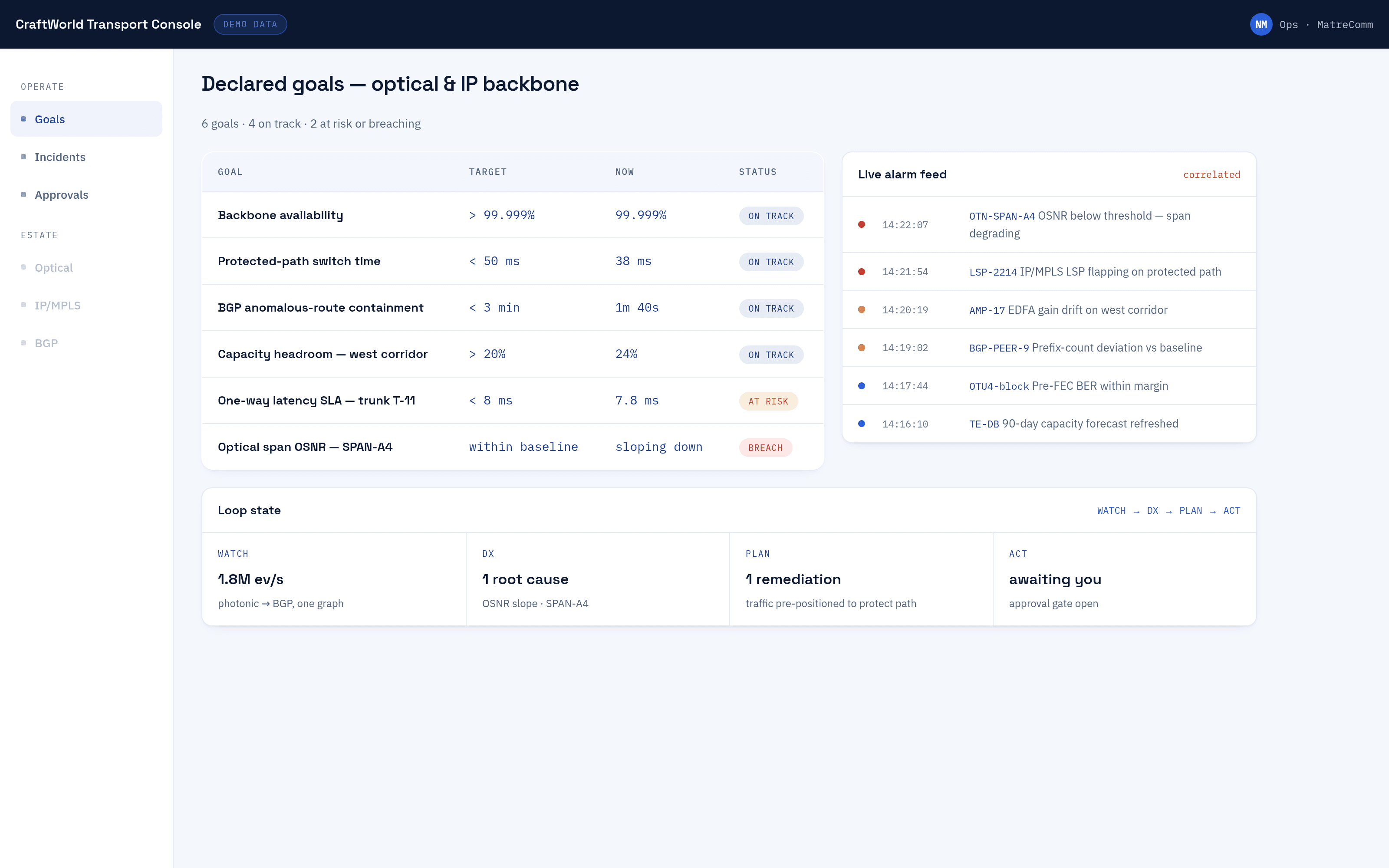
The transport goals you own — availability, latency, protection and capacity — tracked continuously, with Ritam flagging and pre-empting anything drifting toward breach.
| Goal | Target | Now | Status |
|---|---|---|---|
| Backbone link availability | 99.999% | 99.999% | On track |
| Latency SLA — core wavelengths | < 8 ms | 6.2 ms | On track |
| Unprotected spans | 0 | 1 | At risk |
| TE-trunk capacity headroom | > 20% | 23% | On track |
| BGP route-leak events | 0 | 0 | On track |
A span fails in 60 minutes — Ritam acts in 10.
TSLAM4b learns each span's optical fingerprint. When OSNR slopes, it knows a fault is coming — and pre-positions traffic before the customer ever sees it. The availability goal never dips.
TSLAM4b detects an OSNR slope-change on span MUM-PUN-04 — outside its learned baseline.
ARGUS confirms the fault trajectory; predicts OTN LOF/LOS within ~60 min.
Ritam pre-positions traffic on the protected ROADM path; validates the new-path OSNR.
Re-route executed on approval, ticket auto-raised — the span drops later to zero customer impact.
Autonomous across optical and IP.
Ritam operates the backbone end-to-end — DWDM/OTN optical, IP/MPLS routing and BGP — with autonomous, standards-based actions on approval.
Optical — DWDM / OTN
IP / MPLS / BGP
Assurance & OAM
Native across every transport vendor.
One control plane over a multi-vendor backbone — no middleware. Every integration is production-validated and correlates optical and IP regardless of which vendor sits at each layer.
Optical / DWDM / OTN
Ciena · Infinera · Nokia · Fujitsu · Huawei OptiX · Lumentum · ADTRAN · Ribbon
IP / MPLS / Routing
Cisco IOS-XR · Juniper JUNOS · Nokia SR OS · Huawei VRP · Arista EOS
Assurance & OAM
BFD / LSP-Ping · RSVP-TE · G.709 OTN overhead · TCM · protection-switch validation
See CraftWorld Transport in action.
The optical and IP backbone as one layer — span health, OSNR trend and the LSPs riding it.
What goal-driven transport delivers.
From reactive protection to a pre-emptive, five-nines backbone — measurable from the first quarter.
Three domains, one autonomous engine.
Mobility, transport and access run the same goal-driven model on one engine — Ritam, the carrier hub. Prove one, extend across the network.
Mobility
5G core, RAN & subscriber edge — session, QoE and slice SLA.
Explore →Transport
Optical & IP backbone — five-nines availability, latency, protection.
You are hereAccess
FTTx, PON & fixed wireless — provisioning, fibre MTTR, per-sub SLA.
Explore →The backbone console.
Optical + IP correlated topology, OSNR sloping on a span, re-route queued.
Frequently asked questions
What is CraftWorld Transport?
CraftWorld Transport manages DWDM, OTN and IP/MPLS as a single backbone against declared goals — availability, latency and protection targets — held true by the Ritam AIOps engine. Degrading optical performance is identified ahead of the fault, not after protection switches.
How does CraftWorld Transport correlate optical and IP faults?
CraftWorld Transport holds optical and IP layers on one cross-layer causal graph — optical → LSP → service — so an optical fade and the routing churn it causes form one incident rather than two tickets chased by separate optical and IP teams.
Can CraftWorld Transport forecast capacity exhaustion?
Yes. CraftWorld Transport forecasts trunk exhaustion 90 days ahead, so capacity augments are planned as budgeted CapEx rather than discovered when a trunk congests.
Does CraftWorld Transport protect against BGP hijacks and route leaks?
CraftWorld Transport monitors peer sessions and prefix announcements to detect route leaks and anomalous origins, then assembles a containment plan — typically route filtering — showing the exact change before anything executes. Containment can run automatically for defined event classes or require operator approval.
How does CraftWorld Transport work alongside our vendor element managers?
A vendor NMS manages that vendor's equipment and little else. CraftWorld Transport operates across DWDM, OTN and IP/MPLS regardless of supplier, correlates between them, and acts through the vendors' own interfaces — it sits above element managers rather than replacing them for device-level configuration.
See Ritam hold five-nines.
A performance-guaranteed PoC on your optical & IP backbone — baselined, KPI-gated, reversible.