Goal-driven RAN,
core & subscriber.
Experience is the SLA. Declare session success, call quality and slice targets across 5G core, RAN and subscriber edge — and let Ritam (our AIOps engine) hold them, pre-empting congestion before the customer feels it.
Core and RAN as one causal graph — UPF → gNB → session — not three separate tickets.
The subscriber feels it before the NOC sees it.
Core, RAN and subscriber KPIs live in separate tools. Congestion, dropped sessions and slice-SLA breaches surface as customer complaints and churn — not as a signal the network acts on in time.
Mobility, managed by experience goals — not KPIs.
You declare the subscriber-experience goals the network must hold. Ritam correlates core, RAN and edge, predicts congestion and quality drops, and acts — SON, PRB and slice adjustments — before the customer ever notices.
Five layers, one control plane — each with its SLA.
CraftWorld covers the full mobility stack from the 5G core to the subscriber's device — monitoring and controlling every layer, and holding a declared experience SLA at each.
| Layer | CraftWorld monitors | Ritam controls | SLA / goal |
|---|---|---|---|
| Slicing | Per-slice KPI · NSSF · isolation | Slice reassignment, SLA enforce | per-DNN SLA |
| 5G / 4G Core | AMF/SMF/UPF · UDM · IMS | NF auto-scale, pod restore | session > 99.9% |
| RAN | gNB/eNB · RRC · BLER · PRB | SON, power, PRB re-allocation | cell > 99.95% |
| Massive MIMO | Beam mgmt · beam-failure · SINR | Fallback beam auto-activation | beam recovery |
| CPE / Edge | Signal · bearer · per-sub SLA | Auto-reprovision, bearer reset | per-sub SLA |
A UPF session failure, the gNB it rode and the subscriber bearer all resolve to one root cause in <60 sec — core, RAN and edge correlated.
Coverage, load and experience — on one live map.
A correlated view of the RAN — each cell's load, quality and the core session it serves. When a cell approaches congestion at busy hour, Ritam sees it early and offloads to neighbours before QoE drops.
Congestion building
Declare the experience goals. Own the QoE.
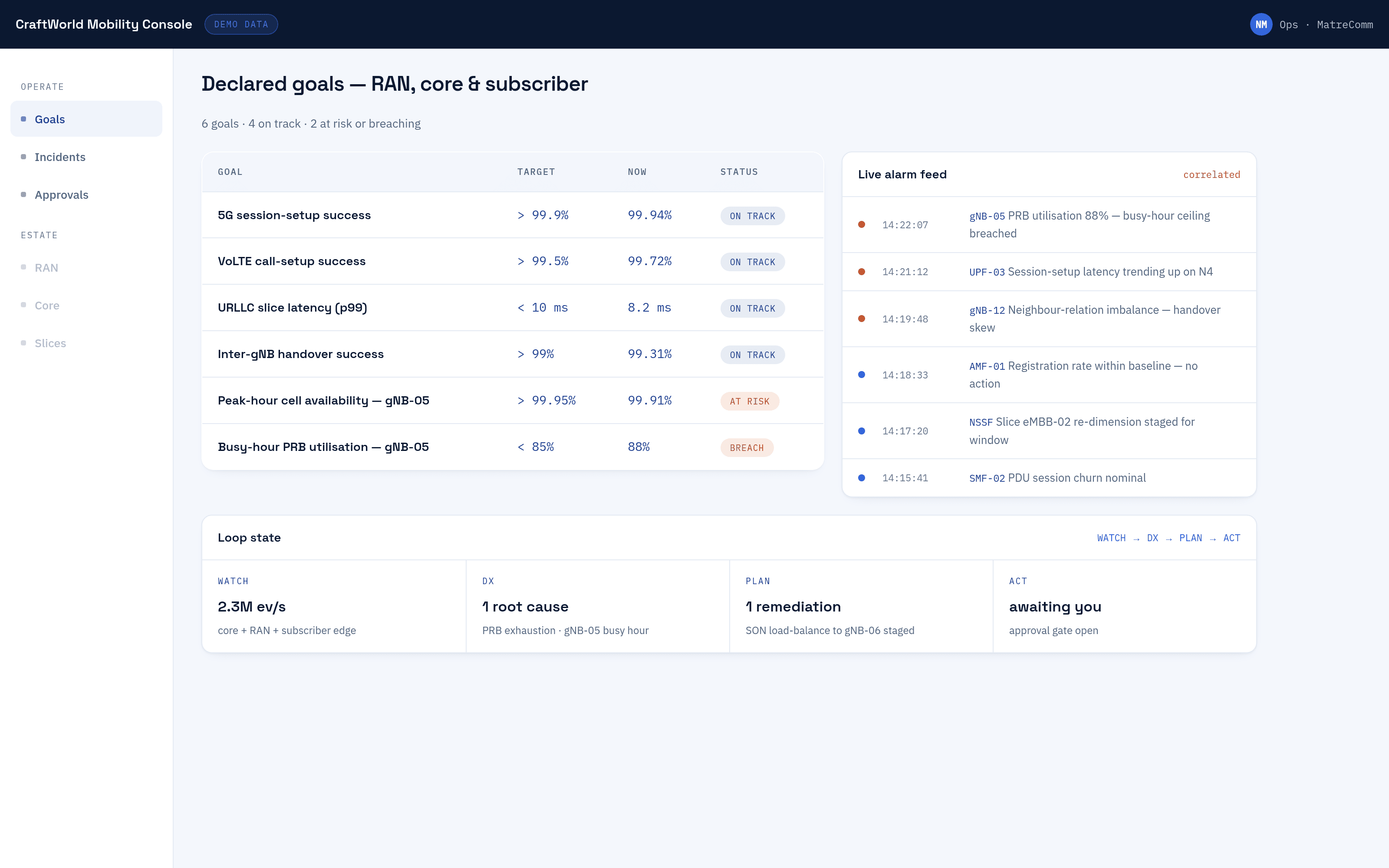
The mobility goals you own — session success, call quality, cell availability and slice SLA — tracked continuously, with Ritam pre-empting anything drifting toward breach.
| Goal | Target | Now | Status |
|---|---|---|---|
| 5G session-setup success | > 99.9% | 99.94% | On track |
| VoLTE / VoNR call quality (MOS) | > 4.0 | 4.2 | On track |
| Peak-hour cell availability | > 99.95% | 99.91% | At risk |
| Data-session setup time | < 100 ms | 78 ms | On track |
| Slice SLA compliance (per tenant) | 100% | 97% | At risk |
Busy hour hits in 25 minutes — Ritam acts now.
TSLAM4b learns each cell's daily load pattern. It sees congestion building before the peak and re-allocates capacity autonomously — so session success and QoE hold through the busy hour.
TSLAM4b sees gNB-05 PRB utilisation trending to saturation ahead of busy hour.
ARGUS confirms: session-setup success will breach 99.9% within ~20 min if unaddressed.
Ritam triggers SON — adjusts tilt/power, re-allocates PRBs, offloads to gNB-06.
Executed on approval — busy hour passes with session success held at 99.94%.
Autonomous across the 5G stack.
Ritam operates the mobility stack end-to-end — 5G core network functions, RAN radio management, and the subscriber edge — with autonomous, 3GPP-compliant actions on approval.
5G / 4G Core
RAN — gNB / eNB
Subscriber Edge
Native across every mobility vendor.
One control plane over a multi-vendor mobile network — public and private 5G — correlating core, RAN and edge regardless of which vendor sits at each layer.
5G / 4G RAN
Nokia AirScale · Ericsson · Samsung · Huawei AAU · CommScope · Baicells
Core (public)
Nokia · Ericsson Cloud Core · Huawei 5GC · Samsung · Mavenir
Core (private 5G)
Open5GS · Athonet · Druid · OAI · Free5GC · Mavenir
See CraftWorld Mobility in action.
The RAN and core, correlated — cell load, session success and slice SLA on one live view.
What goal-driven mobility delivers.
From reactive SON to pre-emptive, experience-first operations — measurable from the first quarter.
Three domains, one autonomous engine.
Mobility, transport and access run the same goal-driven model on one engine — Ritam, the carrier hub. Prove one, extend across the network.
Mobility
5G core, RAN & subscriber edge — session, QoE and slice SLA.
You are hereTransport
Optical & IP backbone — five-nines availability, latency, protection.
Explore →Access
FTTx, PON & fixed wireless — provisioning, fibre MTTR, per-sub SLA.
Explore →The RAN console.
Live cell grid with gNB-05 congested, PRB offload staged, session-success goal tracking.
Frequently asked questions
What is CraftWorld Mobility?
CraftWorld Mobility manages the 5G core, RAN and subscriber edge against experience goals — session success, call quality and per-slice targets — held true by the Ritam AIOps engine. Rather than reporting congestion after subscribers feel it, CraftWorld Mobility forecasts saturation and acts ahead of it.
How does CraftWorld Mobility correlate core and RAN faults?
CraftWorld Mobility models core and RAN as one causal graph — UPF → gNB → session — so a core issue and a cell degradation sharing an underlying cause resolve to a single root cause rather than two unrelated tickets in two teams' queues.
How does CraftWorld Mobility handle network slicing SLAs?
CraftWorld Mobility verifies per-slice SLA continuously rather than assuming compliance and checking at audit. A developing breach is pre-empted, with slice reassignment and SLA enforcement available as closed-loop actions subject to your approval policy.
How is CraftWorld Mobility different from SON?
Self-organising network functions react after quality of experience has already dropped, and operate inside the radio domain. CraftWorld Mobility forecasts saturation ahead of busy hour and acts first — PRB re-allocation, power and beam management, including automatic fallback-beam activation on beam failure — and it reasons across the core-to-RAN boundary, where SON has no visibility.
See Ritam hold session success.
A performance-guaranteed PoC on your core & RAN — baselined, KPI-gated, reversible.