Security and network.
One correlation graph.
Stop triaging alerts. CraftSecOps puts security operations on the same correlation graph as your network — so Ritam reasons across both, and a thousand alerts resolve to the one incident that caused them.
The SOC sees what the NOC sees. An attack that hides in the seam between them has no seam left to hide in.
Your SOC drowns while the attacker walks.
Security operations run on alert volume: thousands a day, most false, each triaged by hand. Meanwhile the network team sees half the picture, the security team sees the other half, and the incident lives in between.
Security, managed by goals — not queues.
You declare the security outcomes you're accountable for — detection time, containment time, noise rate. CraftSecOps holds them true, and ARGUS turns every alert storm into one named cause with the evidence attached.
SIEM + SOC automation — on the network's own graph.
Two co-equal pillars on the same substrate that runs your network operations. Detection sees security telemetry; correlation sees everything — so a security alert with a network cause, or a network fault with a security cause, resolves either way.
SIEM on the correlation graph
SOC automation, goal-gated
Own the number.
You set the security goals you're accountable for; CraftSecOps tracks target vs realised, and Ritam flags what's at risk — with the causal trace already attached.
| Security goal | Target | Now | Status |
|---|---|---|---|
| Mean time to detect | < 5 min | 3.2 min | On track |
| Mean time to contain | < 30 min | 41 min | At risk |
| Alert noise reduction | > 90% | 93% | On track |
| Critical patch SLA | < 72 h | 58 h | On track |
| CERT-In reporting SLA | 100% < 6 h | 100% | On track |
Security means something different in each vertical.
BFSI, telecom and government security models out of the box.
Security is regulatory survival
For a bank, a missed detection is a reportable incident. CERT-In's 6-hour reporting window and RBI cyber-security guidelines leave no room for triage backlogs.
Security is network integrity
For an operator, the attack surface is the network itself — signalling, DNS, management planes. Security events and network events are the same events, seen by two teams.
Security is sovereignty
For government networks, telemetry cannot leave the premises. Cloud SIEMs are a non-starter; the SOC must run air-gapped with full data residency.
From 1,800 alerts to one contained incident — in one view.
A single attack, traced across security and network telemetry to one root cause, contained with the evidence bundle already built.
TSLAM4b flags an authentication anomaly — 1,800 correlated alerts across WAF, auth logs and NetFlow
ARGUS walks the graph: one credential-stuffing source, one compromised account, one lateral hop
Playbook queued — isolate the host, revoke the session, block the source range. Approved in one click.
Timeline, indicators and actions bundled automatically — CERT-In report drafted inside the 6-hour window.
Augments your SIEM. Runs where your data must stay.
CraftSecOps ingests from the security stack you already run — and keeps every byte of telemetry on your premises.
Open ingestion
Syslog, CEF, NetFlow/IPFIX, EDR and cloud-audit feeds — the sources you have, no forklift.
Sovereign by design
Fully on-prem, air-gap capable. Detection models and the LLM reason locally — no telemetry offshore.
Augments, doesn’t replace
Sits above Splunk, QRadar, Sentinel — adds the causal graph and goal layer while your SIEM keeps its role.
What goal-driven security operations deliver.
From alert queues to owned outcomes — measurable from the first quarter.
[ ] bracketed values to confirm against account baseline.
A de-risked path — delivered with your SI.
Every stage is co-funded, KPI-gated and reversible. For large accounts we deliver through your Tier-1 SI partner.
Security posture workshop
Map your alert sources, SIEM estate and SOC workflows. Declare the security goals that matter and baseline MTTD, MTTR and alert noise.
You bring: Alert-source inventory · current SIEM/SOAR tooling
Correlated PoC
Security and network telemetry on one graph for 2–3 critical segments. Goals tracked live against KPIs agreed upfront.
You bring: Co-funded PoC · log and flow feeds
Full SOC rollout
Goals across the estate, ARGUS triage and containment playbooks live. SI-delivered, augments your existing SIEM rather than replacing it day one.
You bring: Subscription · zero additional CapEx
The programmable enterprise suite.
One AIOps engine underneath — Ritam. Prove one surface, extend without re-integrating.
CraftSecOps
SIEM and SOC on the network's own graph.
You are hereCraftSASE
Access policy and network ops, unified.
Explore →CraftCompliance
Hold your posture true, continuously.
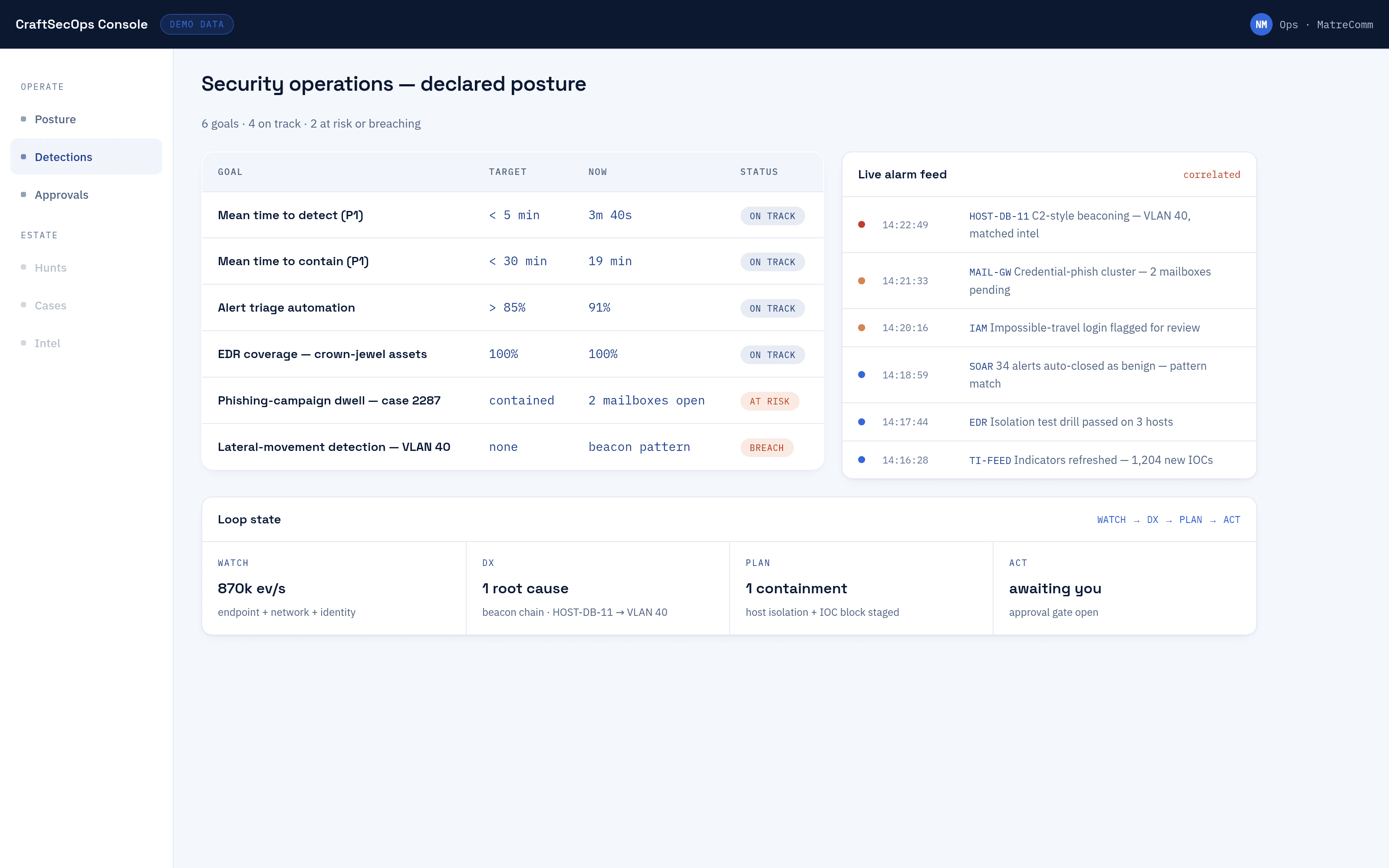
Explore →The SOC console.
Goals, live incidents, and the causal trace from alert storm to contained root cause.
Frequently asked questions
What is CraftSecOps?
CraftSecOps puts security operations and SIEM on the same correlation graph as network operations — one causal engine, Ritam, triaging alerts, tracing attacks across both planes, and holding declared security goals true. It ingests the sources you have — syslog, CEF, NetFlow/IPFIX, EDR and cloud-audit feeds — with full retention on-prem.
Why put NOC and SOC on one graph?
Separate tools and separate graphs over the same events mean the attacker exploits the seam between them. On CraftSecOps, a security event and a network event touching the same infrastructure resolve to the same entity — removing the failure mode where the SOC works an incident as an attack and the NOC works it as a fault, for hours, before anyone establishes it is one event.
Does CraftSecOps replace our SIEM?
No — CraftSecOps augments your existing SIEM rather than replacing it day one. It is SI-delivered, typically starting with security and network telemetry on one graph for two to three critical segments.
How does CraftSecOps help with CERT-In's six-hour incident reporting requirement?
CERT-In's Directions require covered organisations to report specified cyber security incidents within six hours of noticing them or being made aware of them — the clock runs from awareness, not from completed analysis. CraftSecOps collapses alert storms to one incident instead of a queue of thousands triaged newest-first, shortening time to detection so triage and evidence assembly fit inside the window. The reporting obligation itself remains yours.
Can CraftSecOps run air-gapped?
Yes. CraftSecOps is a sovereign SOC that reasons on-prem — no telemetry offshore, no cloud dependency, full data residency — which suits government and critical-infrastructure environments where security telemetry cannot leave the estate.
Bring us your noisiest alert queue.
A correlated PoC on your real security and network telemetry — watch a storm resolve to one cause.