Goal-driven FTTx,
PON & last mile.
Service delivery is the SLA. Declare provisioning speed, fibre-fault MTTR and per-subscriber availability across FTTx and fixed wireless — and let Ritam (our AIOps engine) hold them, predicting fibre cuts before the subscriber calls.
One splitter fault resolves to one root cause — not a thousand blind tickets.
The last mile is where SLAs quietly break.
Millions of ONTs, thousands of fibre runs, and a truck roll for every fault. Provisioning is slow and manual, fibre degradation is invisible until the link drops, and one splitter fault becomes a mass-outage guessing game.
The last mile, managed by goals — not truck rolls.
You declare the provisioning, MTTR and availability goals the access network must hold. Ritam automates turn-up, predicts fibre degradation, and localises faults to the exact ODN segment — so field goes to the break, not the guess.
Five layers, one control plane — each with its SLA.
CraftWorld covers the full access stack from the OLT to the customer premises — monitoring and controlling every layer, and holding a declared service SLA at each.
| Layer | CraftWorld monitors | Ritam controls | SLA / goal |
|---|---|---|---|
| Business access | Leased-line · E-LINE/E-LAN · CoS | Bandwidth profile, CoS enforce | leased-line SLA |
| Service / BNG | PPPoE/IPoE · RADIUS · QoS | Zero-touch provisioning, reset | provision < 2 hr |
| FTTx / PON | GPON/XGS-PON · ONT Rx · BER | ONT re-provision, ranging reset | ONT > 99.9% |
| OLT | Port / PON-card health · uplink | Card failover, traffic re-home | port availability |
| Fibre plant / ODN | Optical loss · splitter · reflectance | Fault localisation, field dispatch | MTTR < 2 hr |
An ONT Rx-power fade, the PON tree it sits on and the OLT port all resolve to one root cause — pinpointing the exact ODN segment, not just the port.
From OLT to ONT — the whole PON tree, live.
A correlated view of the PON — OLT, splitters and every ONT, each with its optical health. When a branch’s loss climbs, Ritam localises the fault to that ODN segment and predicts the cut before the link drops.
Loss climbing
Declare the service goals. Own the MTTR.
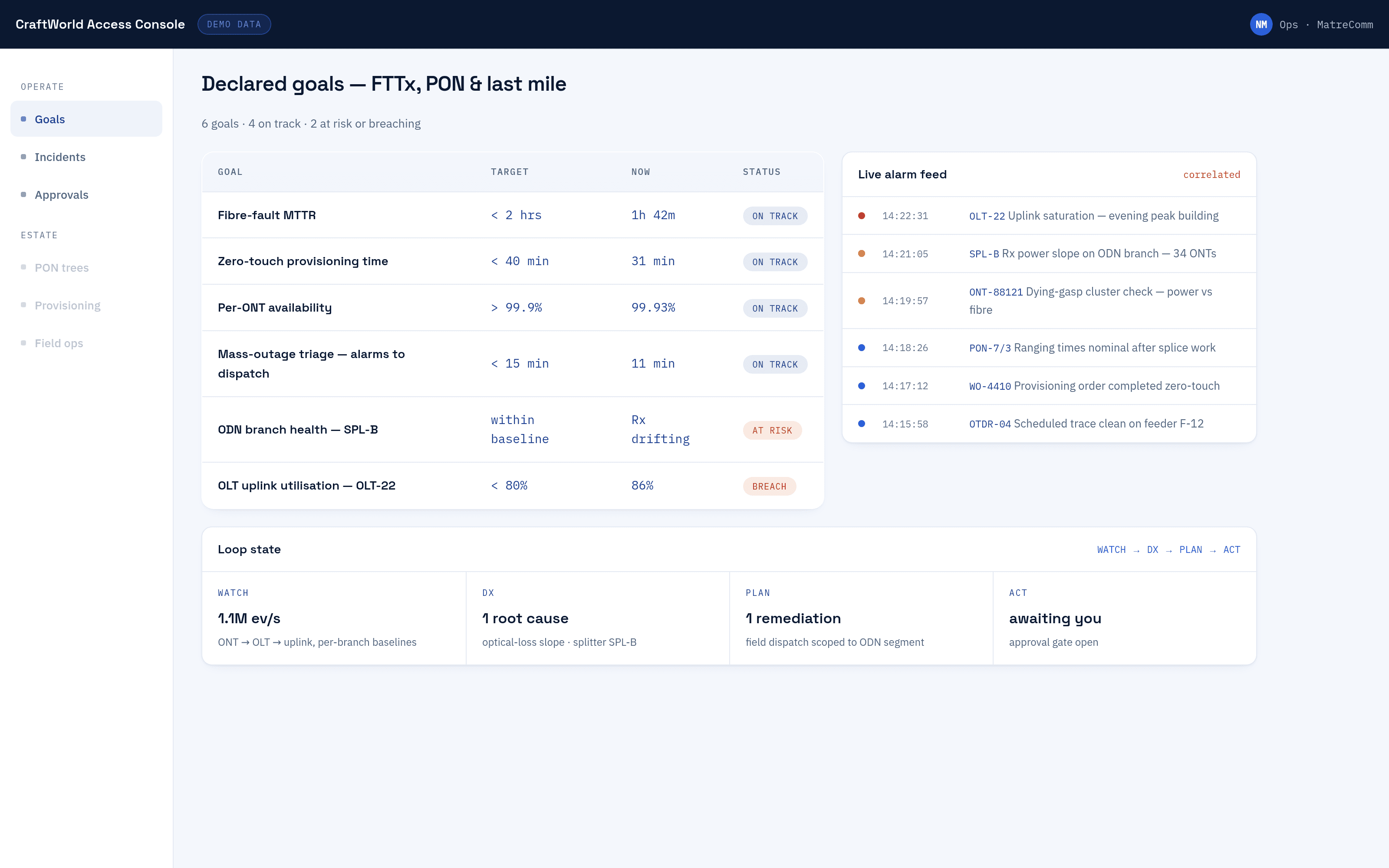
The access goals you own — provisioning speed, fibre MTTR, per-ONT availability and mass-outage triage — tracked continuously, with Ritam pre-empting faults before the subscriber calls.
| Goal | Target | Now | Status |
|---|---|---|---|
| Fibre-fault MTTR | < 2 hrs | 1h 42m | On track |
| Enterprise provisioning time | < 2 hrs | 38 min | On track |
| Per-ONT availability | > 99.9% | 99.87% | At risk |
| Mass-outage triage time | < 15 min | 9 min | On track |
| Fibre cuts predicted (vs reactive) | > 80% | 71% | At risk |
A fibre cut in 45 minutes — field is already rolling.
TSLAM4b learns each ODN branch’s optical-loss signature. A creeping Rx-power fade means a splice or bend is failing — Ritam localises it and dispatches to the break point before the link drops.
TSLAM4b detects an Rx-power slope on SPL-B branch 2 — 38 ONTs downstream.
ARGUS correlates reflectance & loss profile — a degrading splice, not a config issue.
Ritam localises to the ODN segment (not just the OLT port) and raises a proactive work order.
Field dispatched to the splice point on approval — repaired before any subscriber drops.
Autonomous across the last mile.
Ritam operates the access network end-to-end — fibre plant, PON, service edge and business circuits — with autonomous, standards-based actions on approval.
Fibre & PON
Service Edge
Business Access
Native across every access vendor.
One control plane over a multi-vendor access network — GPON, XGS-PON and fixed wireless — correlating fibre plant, OLT and service edge regardless of vendor.
OLT / PON
Nokia · Huawei · ZTE · Calix · ADTRAN · DZS · Ribbon
ONT / CPE
Nokia · Huawei · ZTE · Calix · Sercomm · multi-vendor OMCI
Fixed wireless / BNG
Cambium · Tarana · Cisco BNG · Juniper BNG · RADIUS / TR-069
See CraftWorld Access in action.
The PON tree, live — OLT to ONT, with fault localisation to the exact ODN segment.
What goal-driven access delivers.
From truck-roll-driven operations to pre-emptive, automated service delivery — measurable from the first quarter.
Three domains, one autonomous engine.
Mobility, transport and access run the same goal-driven model on one engine — Ritam, the carrier hub. Prove one, extend across the network.
Mobility
5G core, RAN & subscriber edge — session, QoE and slice SLA.
Explore →Transport
Optical & IP backbone — five-nines availability, latency, protection.
Explore →Access
FTTx, PON & fixed wireless — provisioning, fibre MTTR, per-sub SLA.
You are hereThe access console.
PON tree with a degrading branch, fault localised to the ODN segment, field WO raised.
Frequently asked questions
What is CraftWorld Access?
CraftWorld Access runs FTTx, PON and fixed wireless access networks against declared goals — provisioning speed, fibre-fault MTTR and per-subscriber availability — held true by the Ritam AIOps engine. Fibre degradation is predicted before the subscriber calls.
How fast is service provisioning with CraftWorld Access?
CraftWorld Access performs zero-touch service turn-up, bringing a service live in minutes where manual provisioning is typically measured in days.
Can CraftWorld Access predict fibre faults before they drop the link?
Yes. CraftWorld Access detects a degrading ONT receive-power slope 30–60 minutes ahead of link failure and localises the fault to an ODN segment rather than reporting it at the OLT port — so the field crew is dispatched toward the break, not the exchange.
What happens during a mass outage on a PON?
CraftWorld Access auto-correlates the resulting subscriber tickets to the single splitter or feeder root cause, so a mass PON failure presents as one incident with a known cause rather than thousands of individually-worked tickets with no shared context.
See Ritam predict a fibre cut.
A performance-guaranteed PoC on your fibre plant & PON — baselined, KPI-gated, reversible.